
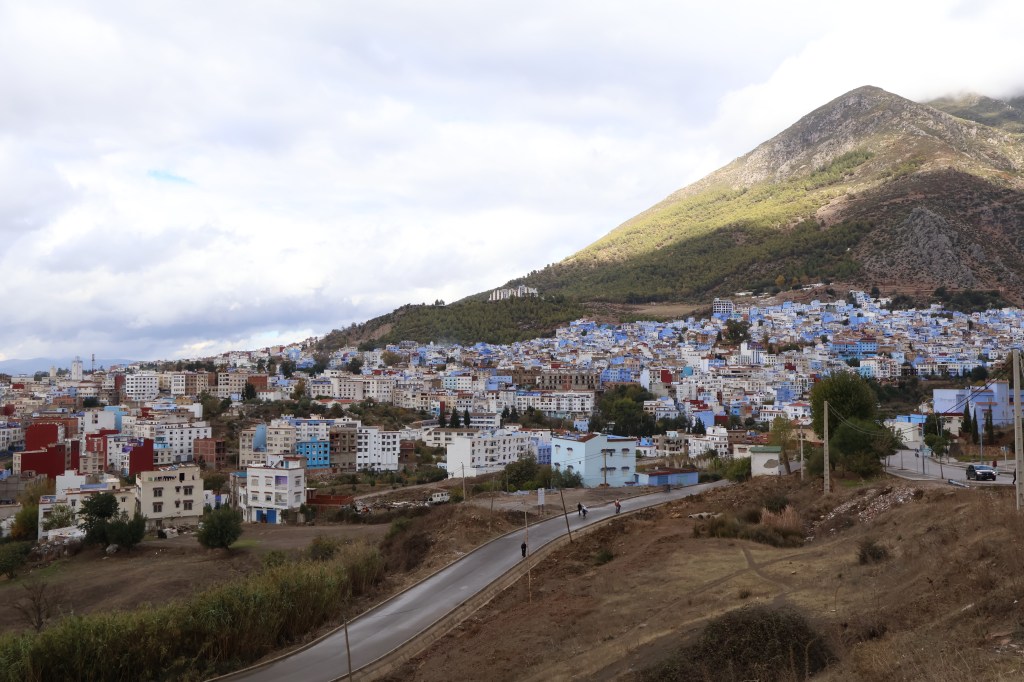
I arrived in Chefchaouen at around 1PM, with the day halfway over and a 6 hour bus ride behind me. I stood at the bus station on top of a mountain in a city painted blue. I had an idea of a plan, and once again called upon Mustafa to assist me. When we were traveling together I had mentioned to Mustafa my desire to see Chefchauen, but had no idea where to stay as there didn’t seem to be much in the way of lodging in the city this time of year. He had kindly and without hesitation said he would take care of it for me, and after one phone call arranged for me to use the apartment that he would rent when he would stop in Chefchaouen. I hailed a taxi and made my attempt to explain the address to him of where I needed to go and failed spectacularly at showing him the place, I must’ve copied it wrong. The driver told me it didn’t exist. I sat in the back of the taxi cab awkwardly and panic dialed Mustafa.
Mustafa picked up and I blurted out that I had no idea how to get there and the taxi driver was telling me the place didn’t exist. Mustafa said to hand my phone to the driver and he’d explain. I was nervous to hand over my phone to a stranger. Honestly, I was nervous just to be on my own in a car with someone who I couldn’t communicate with but at the moment I felt as if I didn’t have much choice. I realize I could’ve just gotten out of the cab and tried again but hindsight is always 20/20. Your nerves will always win out if you let them and I was super uncomfortable and unhappy with my current situation, exhausted from the bus ride and just not really looking forward to Chefchouen. I handed the phone to the driver and after a few minutes of back and forth the driver hung up and handed the phone back to me, and off we went to the outskirts of Chefchaouen.
I texted Mustafa and thanked him once again for his help and after a few minutes up and down the mountain roads I found myself being dropped off down the street from a towering blue three story house. I walked up to the house and a large Moroccan man with a turban on opened the door to the house and came out to greet me. He shook my hand and took my bag, showed me to a room in the basement of his house and found myself in a room not much larger than a walk-in closet. Only a mattress, bed frame and nightstand were in the room, and a small window to let in light during the day. I’m not sure what I expected but at this point I just shrugged my shoulders, dropped my bag and began my half day in the Blue City.
It was about a 25 minute walk for me from the house on the hill to the city center and I began the trek already out of breath due to the elevation of the city and my lack of fitness when it came to cardio. My next gem of wisdom for any hopeful traveler would be that you should absolutely get your ass on a treadmill and start building up that endurance for walking. Personally I’ve never been a fan of mindless exercises like running, or cardio exercises in general but the amount of times I’ve found myself out of breath or panting after 20 minutes of walking is embarrassing to admit, and does not help with the “fat, out of shape American” stereotype that lives in the mind of every person outside of the US.
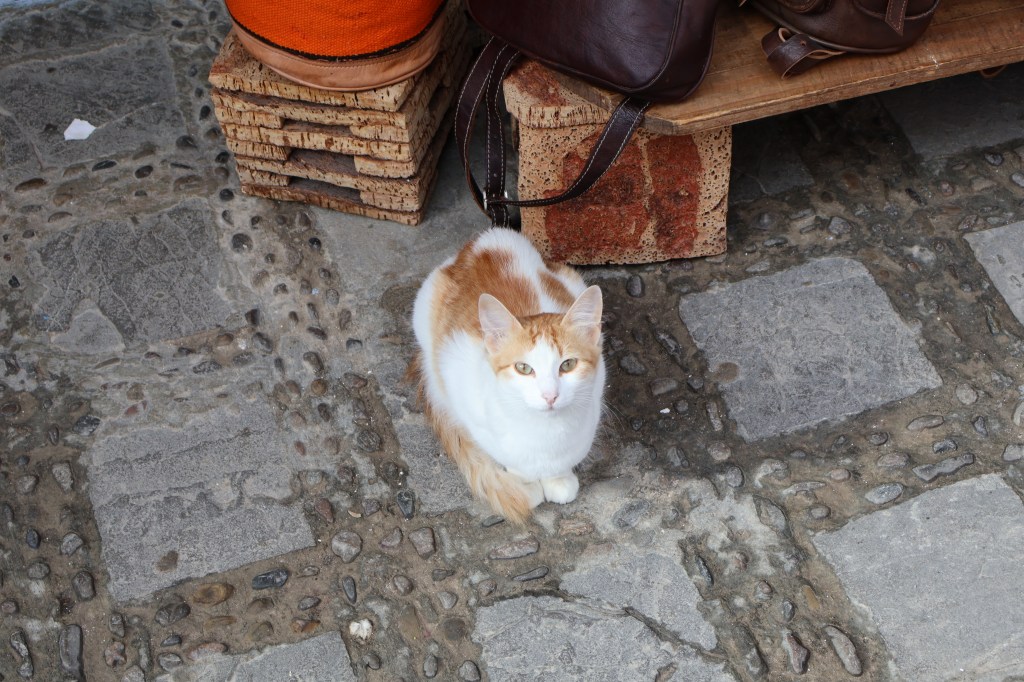
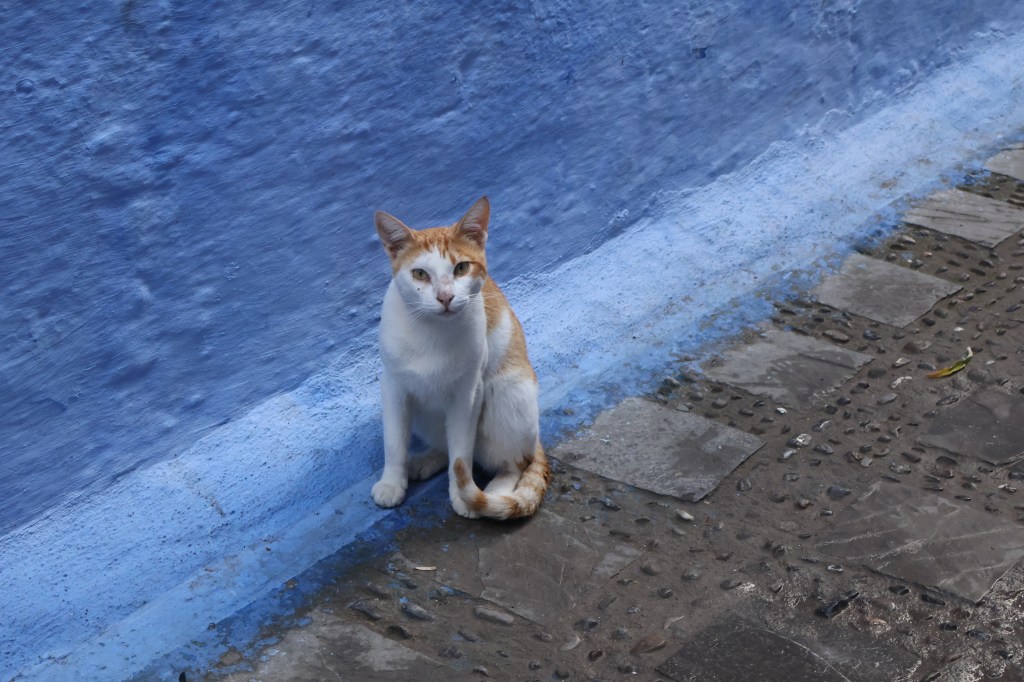
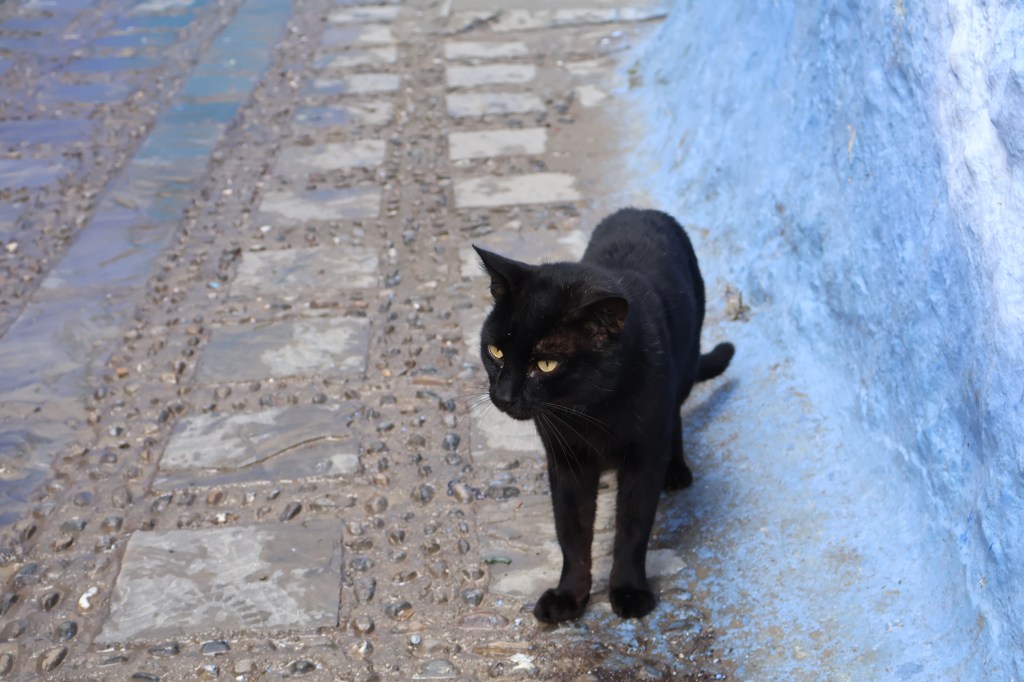
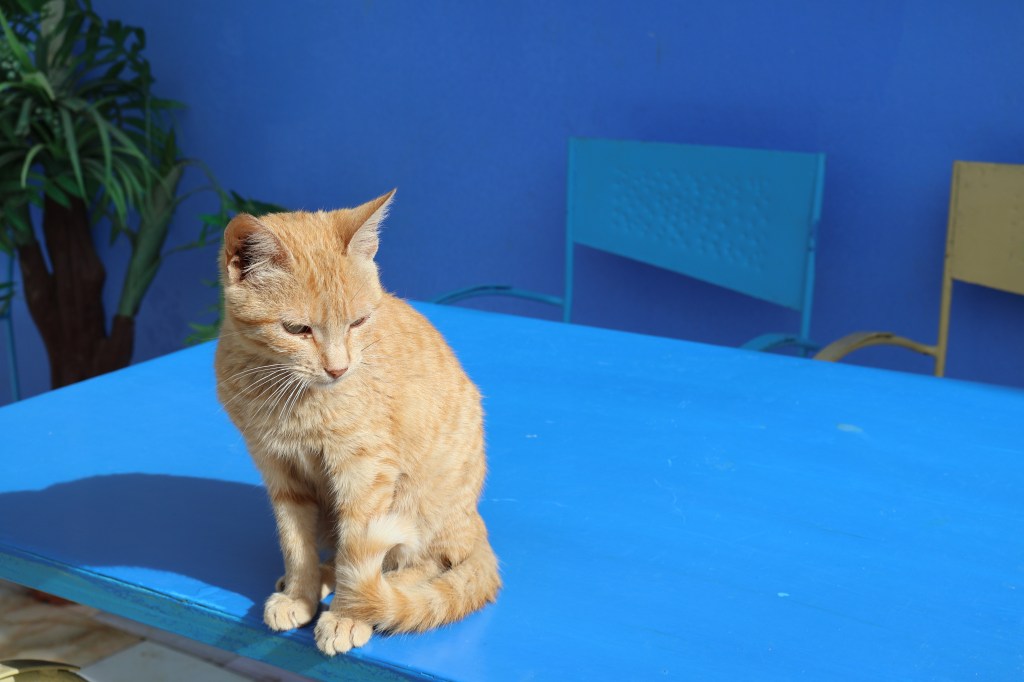
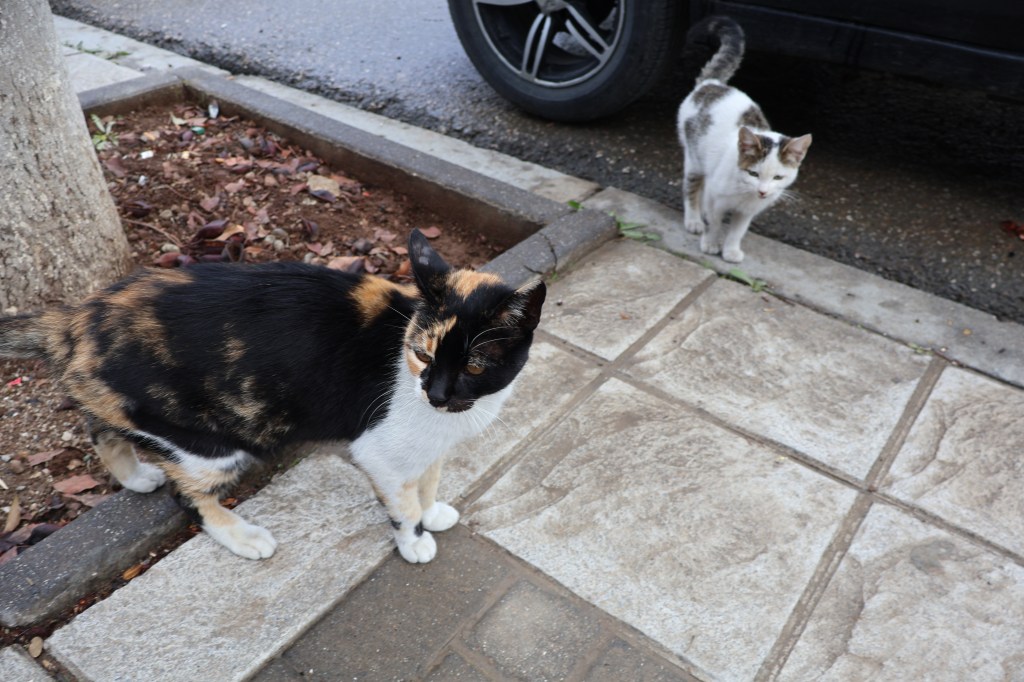
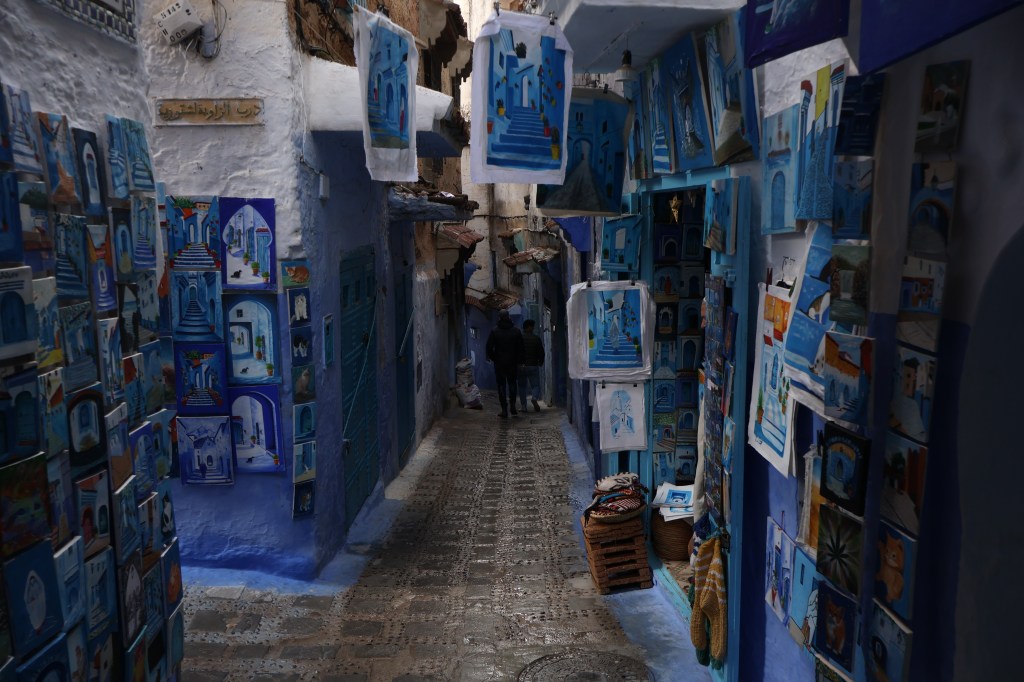
The half day of Chefchouen was exactly what I expected. More markets selling the same clothes, bags, and trinkets I had seen dozens of times before in Marrakesh and Fez, the only difference here was that the aesthetic of the city was much more vibrant. The deep hues of blue painted on every building, stairway, and narrow alleyway gave a sense of wonder to me that stretched into the sky, it was refreshing to me as I had gotten so used to the dark reds, yellows and oranges of Fez, the Sahara and Marrakesh. As I wandered through the alleyways of the city I found myself less and less interested in the markets and started following the local stray cat population around, taking photos of them lounging around living their best life. I think in this moment my desire to care about Morocco had evaporated. I had come to the conclusion there was nothing this country had left that could “Wow” me, except for the cats.
The following morning I was back at the bus station, ready to depart not only Chefchouen but Morocco as well. I made the decision to spend my one extra day in the “White City”, Tangier as at least I had a loose mental connection there that I could explore.
For those who don’t know there were two people who have had massive impacts on my philosophies of travel before I embarked on this trip, and my attempt to remain steadfast and open minded in the face of new obstacles. The first is the last true explorer of the 20th century, Sir David Attenborough. The second is New Jersey’s own, Anthony Bourdain. I plan to go over the influence Anthony specifically has had on my life in a future blog post but all you need to know about Anthony if you are uninitiated is he was a Chef in New York City who wrote a book about his experience working in the kitchens of NYC, and exposing their unexplored underbelly that average restaurant goer was ignorant to. It became a New York Times bestseller, and catapulted Anthony into stardom. He ended up signing a TV deal with the Food Network and hosted a show called A Cook’s Tour which saw him traveling across the planet, trying new foods and trying to educate the viewers on the history of the place he was in.
One of my favorite later episodes Anthony had produced for his third and final show Parts Unknown was on the city of Tangier, and the history of this place had on so many artists in the 20th century. Some of the most influential writers in modern history like Paul Bowles, Jack Kerouac, and William Bouroghs, and even the Rolling Stones arrived in 1989 to work on the song Continental Drift in the city, collaborating with Morocco’s greatest musicians to create the song. So in my head, one day also hoping to have a fraction of the amount of skill and talent that any of those icons of their time had in their pinky, I felt an intense desire to try and understand what was it that attracted so many people here?
In preparation for this entry I went back and rewatched Bourdain’s episode on Tangier to reflect on his thoughts on the city vs mine nearly two years removed from being there. Bourdain spends a long time talking about the writer William S. Bouroghs, a homosexual heroin addict who had murdered his wife and moved to the Tangier International Zone in 1954 and in that time had written some of the most genre defining books of the 20th century, and during the most of the show Bourdain is trying to answer the question “Was Tangier still like what Bouroghs wrote about at that time?” Or had the magic of the city faded? Bouroghs believed Tangier was a place someone could escape society, a city without rules where expats from the West could live free of the chains that bound them to expectations of Europe and the United States. Where adventure and a culture so foreign from your own understanding would transport you to a time long passed. But that was the 1950s. The world is a much different place now. The dark corners of the world had surely been filled in by now, and any sense of the anarchy that attracted expats like Bouroghs was long gone. Anthony never got a clear answer in my opinion and that was in 2013. I was curious to see for myself what I would find. Would it be more of the theme park style tourism that I had encountered in Marrakesh, Fez, and Chefchaouen? Or would I find a city of freedom and anarchy unlike anything I had seen before?
The ride to Tangier was a quick two hour bus ride and by this point I was starting to feel confidence in my conquest of understanding how public transportation worked. As it turns out that morning I was wrongfully overconfident. While I knew the bus from Chefchouen would take me to Tangier I didn’t know how many stops the bus would actually make. I figured a city like Tangier would have several stations that it would stop at. So as we approached the city I checked Google maps and tried my best to figure out where exactly the other bus stations were in Tangier so I could get off as close to my hostel as possible. Instead, the bus stopped once just outside the city, then about half the bus emptied out onto the road, and before I knew it the bus was on a highway South, away from Tangier. I panicked, and bolted up from my seat towards the front of the bus. I asked the driver where we were stopping in Tangier and he shook his head. I said I needed to get to Tangier and begged the driver to stop so I could get off.
The driver pulled off onto the shoulder of the highway and I got off, standing what felt like miles outside Tangier. I was angry at myself for not checking and confirming the stops before I got on the bus. I should’ve gotten off 5 minutes ago with the rest of the bus and taken one of the dozen taxis parked there. Now I stood alone with the whole city towering in front of me. I checked the distance between me and my hostel in the Medina and it was an estimated two hours to walk that distance. I remember the sense of just overwhelming annoyance that came over me as I started my trek back towards the city. Every now and then a taxi would fly by without ever slowing down and I found myself trying desperately to hail a cab each time one drove past but not a single one would stop.
Eventually, after about 45 minutes of walking down the highway, I got to a traffic circle just inside the city. I stood there for about 10 minutes trying to get the attention of any taxi that drove by. I tried shouting, waving, sticking my thumb out, and each time the drivers would slow down, look at me and just wave as they drove by. This was fucking infuriating and I lost my temper as my begging for one of the taxis boiled into a blinding rage and instead of shouting for them to stop I was shouting for them to crash and burn alive. I didn’t understand why they wouldn’t stop for me. If this was Thailand I wouldn’t have been able to walk ten steps without a tuk-tuk or cab stopping to ask where I was going. To this day I still don’t have an answer as to why none of the taxis wouldn’t stop for me. The only cab on my walk towards my hostel that did stop refused to take me once I gave them the address. So what I am saying is I think I was a victim of prejudice.
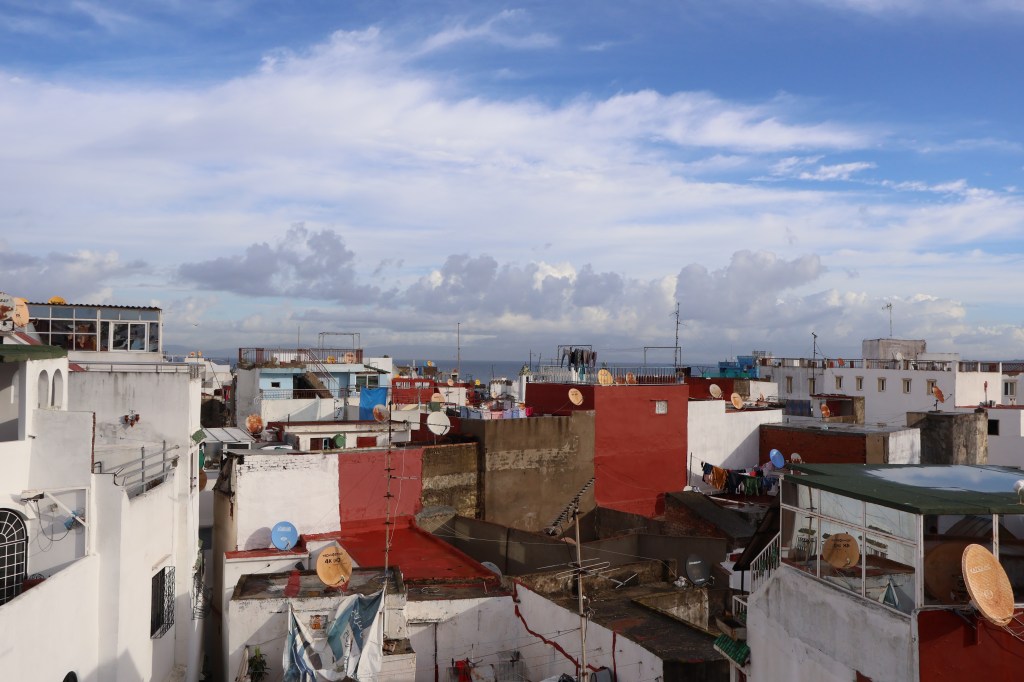
Situationally the path I had to take to get to my hostel led me through the heart of the city. I was at the southernmost part of Tangier, and my hostel was located on the northernmost part of the city, once again in the Medina. I found myself stopping and taking in the traffic, the stores and the smells. I cannot read Arabic but I tried my best to figure out what each sign or store sold as I walked past. In many ways what I saw in the city reminded me of what I saw in Thailand when I visited Koh Samui and Phuket in 2019. You had mechanic workshops sticking out onto the sidewalks from garages, street food vendors on the corners and plenty of stores I couldn’t recognize. But the stereotypical vendors of the Medina were nowhere to be found, no one selling overpriced leather bags, or wood carvings or genie lamps. You felt this is where the people actually lived which as I write this seems pretty obvious, but in my defense almost all of my time in Fez and Marrakesh were spent in the Medinas because I had believed that was where I’d find my adventure and excitement. Chefchouen had been different as it did feel like a town that dedicated its entire identity to tourism. Fancy cafes and restaurants dotted around the entire city catering to Western wallets.
Tangier was different to a degree. Maybe it was because I hadn’t spent time in those other cities like this. Maybe I was just so desperate for something different I shut off the quality control part of my brain and wanted to play in this fantasy sandbox of Tangier that had been described to me.
Finally I found myself at my hostel. Tangier, much like its fellow Moroccan Cities had one thing in common, the Medina was still a maze of twists and turns with no discernible landmarks. It was mid-afternoon and after I checked in there was virtually no one in the hostel. I locked up my backpack and began my exploration.
My first stop was the famous “Cafe Baba”, located inside the Medina. This cafe was famous for where the Rolling Stones came to smoke and drink during their stay in Tangier. More recently Anthony Bourdain came there to shoot for his show, Parts Unknown. Situated in the heart of the Medina on the middle of a set of stairs it was very easy to miss. When I entered I was surprised by the small scale of the cafe. As an American I was used to Starbucks style lobbies in the cafe and several dozen seats for people. But instead this Cafe was small, cramped. It was one room, lined with tables on each side, painted blue and white, with a TV on the opposite side of the wall from the entrance. The entire place had a lingering smell of hashish. I walked up to the counter and the man standing there took my order. I asked for some mint tea and went to sit down.
I realized there was a window seat on the left side of the cafe which overlooked the stairway below and made my way over and took in the customers who had been sitting before I walked in. I was one of two white people in the cafe. Everyone was smoking and drinking, laughing or watching the TV on the wall. Then I noticed something next to the TV, several picture frames all scattered across the wall, I couldn’t distinguish what they were but somehow I recognized them, I felt the urge to get up and investigate. As I got closer it became clear to me they were photos of Anthony Bourdain and the episode he had shot here in this very building.
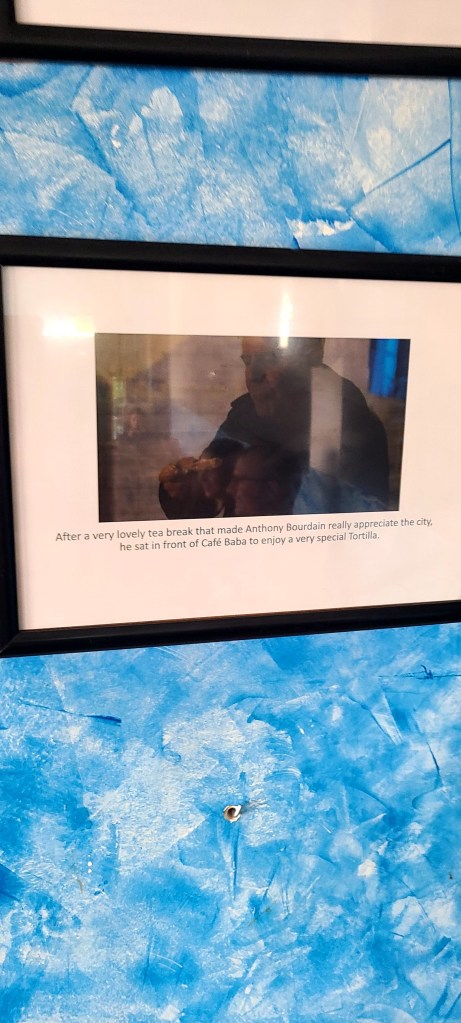
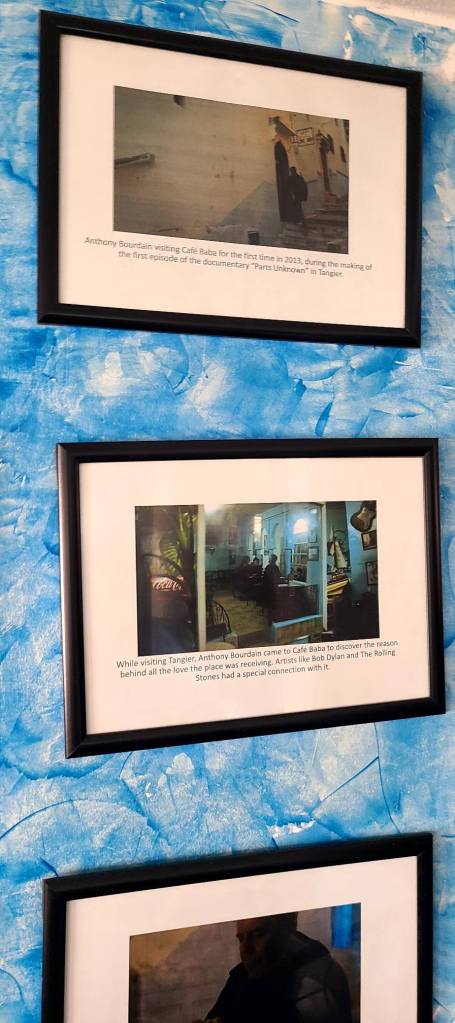
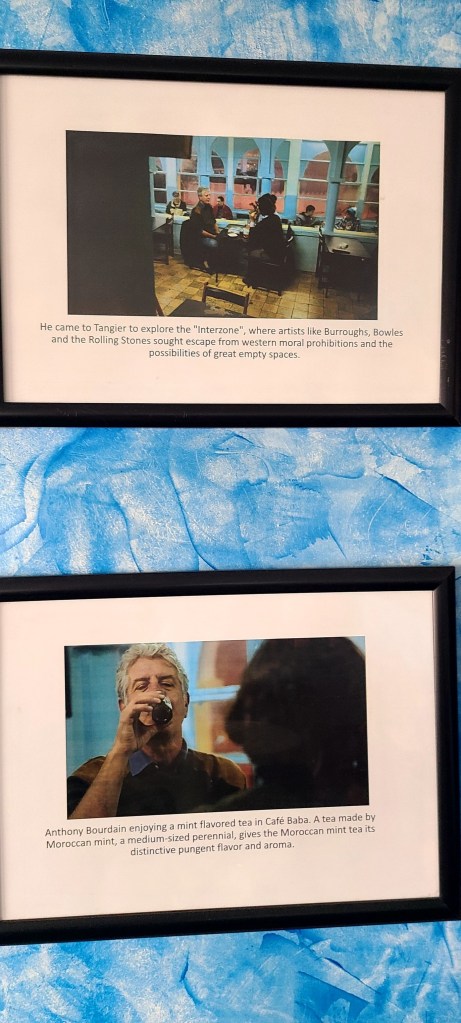
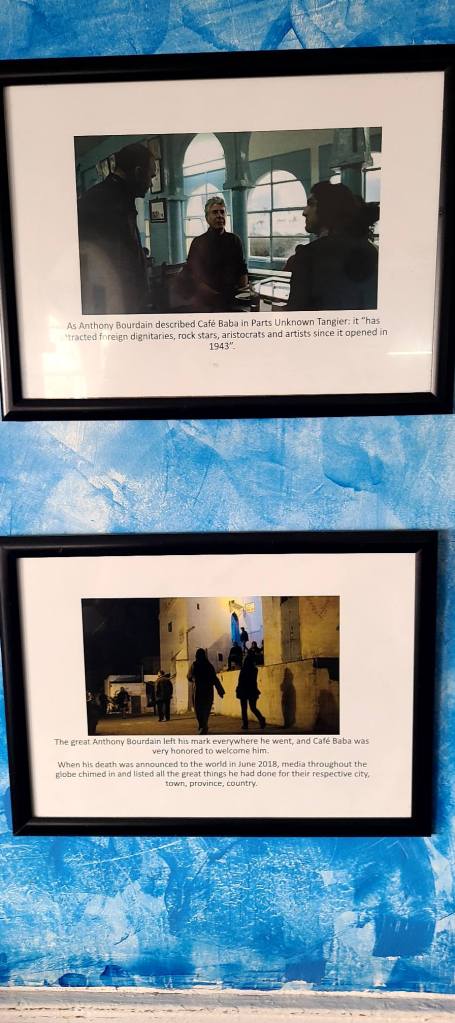
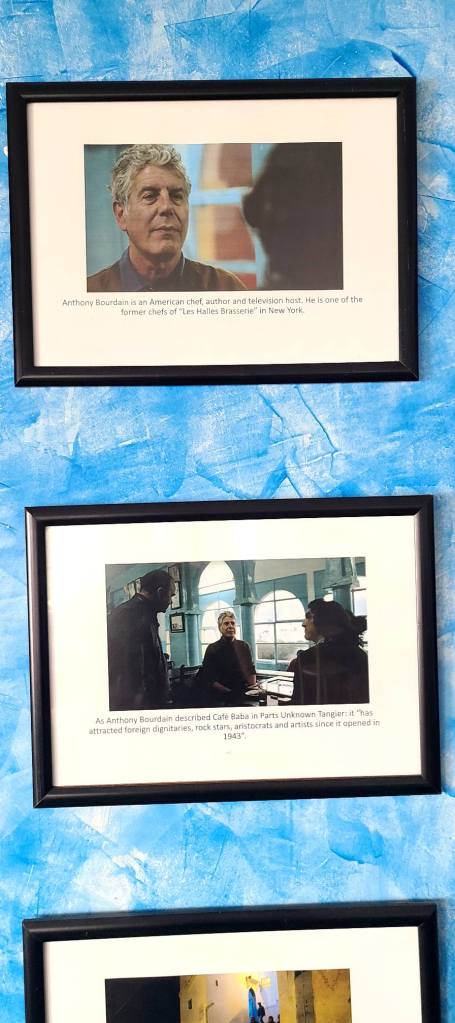
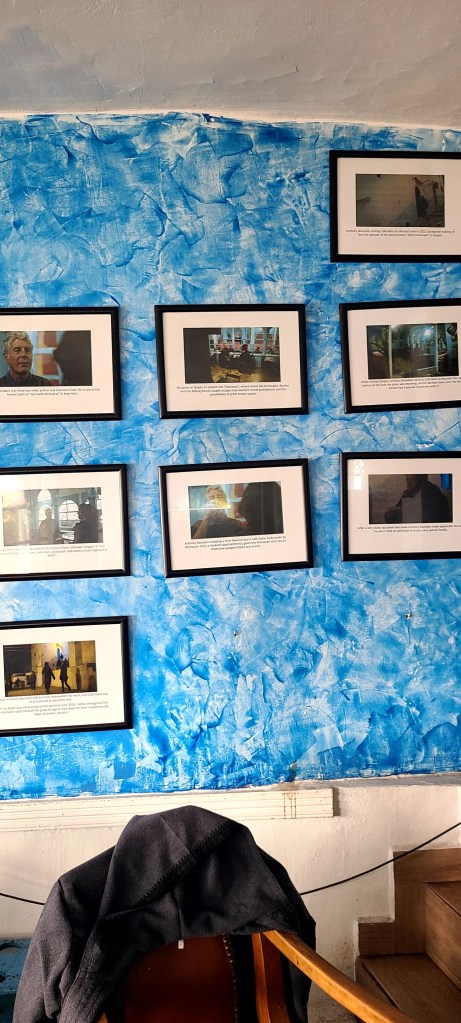
In that episode of Parts Unknown I remember being particularly moved by a comparison Anthony made of the expectations and desires of an expat from the West and a Tangier local in Cafe Baba. The cafe had a long and storied history in the community as a “Third Place”, somewhere people would go to exchange ideas, relax, socialize and discuss topics. Anthony pointed out the TV on the wall, the same one I had noticed upon my entrance to the building and explained to an expat, this was “Ruining the authentic experience of Tangier.” but to a local, who has lived in Tangier and can’t afford a TV in their home, this was a massive development, now he can come here and watch his sports, or the news or whatever he desires.
That conversation always stuck with me after the first time I watched the episode, about understanding how things change. I now pondered how it related to my experience in Morocco as a whole. Time moves in one direction, and that’s forward. So much of what I wanted out of this country I hadn’t found, in its place I found salesmen pretending that still existed. Did I have a justifiable frustration in trying to masquerade as this adventurer in a country, or a place I didn’t feel like had a right to advance into the 21st century?
I remembered a conversation I had with Mustafa when we were driving up to Fez. At some point during that day The Dolphin had pulled off on a rest stop to use the bathroom, and Mustafa and I went for a walk. We climbed to the top of one of the hills and Mustafa had pointed out to me a giant mine site on the other side of the hill, several miles away where I could barely see it.
“See that? It is a silver mine. It is worked by Moroccans, our blood, our sweat, our bodies. But every bit of it goes to France. Because of a deal our King signed in the 1800s. How can Morocco ever grow as a country if all our resources go towards keeping Europe rich?” Said Mustafa.
And that sentiment never rang truer than now as I began to understand my hubris with Morocco. It was a country trying to grow out of its stereotype and into the digital age. Tourism was necessary for the economy because there was no other way for them to make a successful living. When your industry is being exported to another country like that, (assuming of course that what Mustafa told me was true) you resort to whatever you can. Morocco does not wield the power a country like the United States or China can, and dictate the terms of a trade deal or agreement. It has to make due with what it has in its hand.
Despite this memory in my head, my frustrations over the last few days with the country made me feel like there was still nothing left here to impress me. Through Tangier I hadn’t felt a taste of what may have been before, a true “Wild West” of freedom and expression. I now sat similar to how I felt on the train ride to the airport in London, wondering what if anything I had learned. I had one more day in Morocco and I was scratching my head as to what else there was for me to experience here. What was the revelation? What was the lesson? Did I do everything I wanted? I had crossed off a bucket list goal and yet my brain had barely registered it.
Fortunately I didn’t know it at the time, but tomorrow I would meet a stranger who would help me come closer to the understanding I was so desperate to find.
 ChrisCrossesCountries
Leave a comment